Why sugar beet farmers are all in on GMOs
By Annie Baxter
August 09, 2016 | 9:55 AM
Listen to this story
Duck%20looking%20downDuck (Daniel) Younggren in one of his sugar beet fields in Hallock, Minn. His family has been growing sugar beets there since 1965 and started using genetically modified seeds nearly a decade ago. – Annie Baxter/Marketplace
Duck Younggren seems to be in the right line of business for someone with a sweet tooth. He grows sugar beets in northern Minnesota. He’s been known to gnaw on a beet to get his sugar fix.
“Core out a piece. Put it in your mouth,” he said. “It’s like candy!”
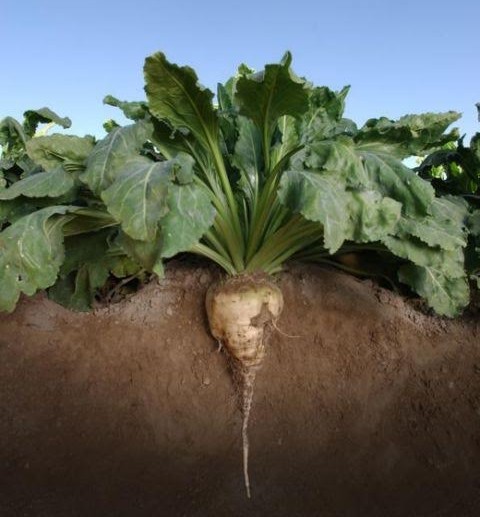
Younggren, who’s real first name is Dan, grows sugar beets in the Red River Valley, the largest area of sugar beet production in the U.S. About 60 percent of domestic sugar production comes from sugar beets– a fact that has started to attract attention due to consumers’ worries about GMO crops.
Nearly a decade ago, Younggren and virtually all other sugar beet producers started growing crops that were genetically modified to resist the herbicide glyphosate, also known as Roundup.
It was stronger than the old herbicides. And Roundup doesn’t beat up the sugar beets, so their leaves grow a canopy faster, which prevents further weed growth and means fewer herbicide applications.
“We are down to two passes over the field. It used to be five or six,” Younggren said. “We’re saving fuel, we’re saving trips over the field, wear and tear on our machinery, the fatigue of the person doing it. Not to mention the carbon footprint we used to have, is not there anymore.”
The scientific consensus is that genetically modified foods are safe. But some consumers think more studies are needed.
And some worry specifically about the effects of Roundup. Most regulatory bodies say it’s safe, but there has been a lot of disagreement over the matter, even within parts of the World Health Organization.
Weed resistance to glyphosate has also caused problems in parts of the country.
Younggren said his genetically modified sugar beets are now getting a bad rap among consumers.
“We were in a meeting and someone flashed an image up on the screen, and the picture said, ‘Agriculture, meet your new boss,’” he said. “And the picture was a mother in a grocery store pushing her child in a cart. We have to convince the consumer that what we’re doing is safe.”
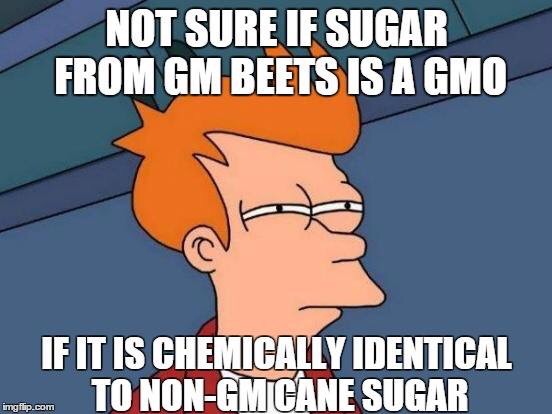
A few big food manufacturers, including Hershey’s, are now moving away from beet sugar to cane sugar, which does not come from genetically modified plants.
BeetsNearly 60 percent of domestic sugar production comes from sugar beets, like this one, grown in the Red River Valley of Minnesota. – Annie Baxter/Marketplace
But there are limits to how dramatic a shift food companies can make.
“They don’t want to commit to doing something if they can’t line up supply,” said Michael Swanson, the chief agricultural economist at Wells Fargo.
Wells Fargo finances both sugar beet and sugar cane operations.
Swanson said U.S. sugar policy puts some restrictions on how much sugar cane there is on the market, from both domestic and foreign sources. It’s tricky to work around. What’s more, sugar cane takes a few years to establish and really only flourishes in a few states.
“We certainly can’t get that much more sugar cane instantaneously,” Swanson said.
Michael McConnell, an economist at the Department of Agriculture, said pricing and deliveries data give some indication that cane sugar is outpacing demand for beet sugar, possibly a sign of GMO fears affecting the market. Cane sugar’s price is now 15 percent higher than beet sugar’s on the spot market. And deliveries of cane sugar are up, whereas beet sugar deliveries are down.
But McConnell said other forces have affected the market, too, like a change in sugar imports from Mexico. So the picture isn’t totally clear.
“There are a number of different factors and forces, both on the supply side and on the demand side,” he said.
Tom Astrup, president of American Crystal Sugar, an agriculture co-op in the Red River Valley, emphasized the effect of supply issues on the market and denied the notion that GMO fears are hurting sales. But he acknowledged that the co-op is considering what for many would be the nuclear option: ditching genetically modified seeds.
Astrup said it would be hard to ramp up the supply of seeds and chemicals for the sugar beet producers in the co-op to do so.
“But at the end of the day consumers are going to decide whether they want food produced using GMO technology,” he said. “And if the consumer should decide on one path or another, we have to be prepared to provide the food product they desire.”
For now, though, farmers in the co-op, including Duck Younggren, think that would be going backwards — using more resources to grow their crops.
Follow Annie Baxter at @anniebaxter123.
Baxter annie 0
Annie Baxter is a senior reporter for Marketplace. She covers a range of topics, with a focus on agriculture and food, from her perch in St. Paul, Minn., where Marketplace’s parent company is headquartered.
Annie has been making radio since 2000, when she pursued an internship at KQED…
Read More
· Twitter: anniebaxter123

 thesweetbeetlife.com